
Sierra de Gata: mountains, valleys, landscapes
Sierra de Gata is one of those fabulous places full of incomparable corners that enrich those who go there. It is located on the border with Portugal; this situation increases its cultural legacy, a memorable magical touch to all the towns and villages of Sierra de Gata.
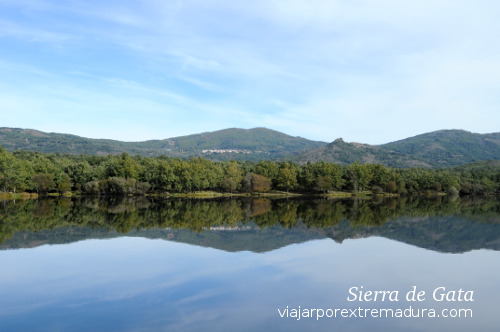 Sierra de Gata beautiful landscapes. Atalaya reservoir
We begin our trip from Moraleja; this town is a ‘natural door’ to the region.
To get there we take the EX-109 road from Coria. In Moraleja the well-known Casa de la Encomienda stands out; King Philip the 5th, on occasion of his travels, stayed there for some days.
Here we are close to Borbollón reservoir, where you may practice water sports such as sailing. It is also a perfect place to practice birdwatching.
A few kilometers away is Cilleros. Here, wineries produce wines which lie for months in vaulted rooms. The Doce Apóstoles church stands out in this town of Sierra de Gata.
Our next stop is Hoyos. This small town has been declared a Historical-artistic ensemble due to its unique architecture. Good examples are La Casa de las Conchas or Nuestra Señora del Buen Varón church, with a beautiful Romanesque door (Romanesque is rare in Extremadura because of the Arab influence until the 13th Century).
 Nuestra Señora del Buen Varon church
Heading north, we reach San Martín de Trevejo, one of the most well-known towns in the area. Its arcade square is worth a visit, as well as going for a walk through the streets where regateras, small gutters in the middle of the street, let the water run away.
 San Martin de Trevejo
San Martín de Trevejo is one of the three towns where A Fala, a dialect which mixes Spanish and Galician, is spoken. Due to its border situation, the towns of Eljas and Valverde del Fresno, along with San Martín, preserve the legacy of an almost extinct culture. Moreover, there are associations which promote and try to make known this unique dialect, considered property of cultural interest.
Acebo is a small town which preserves the art of bobbin lace. As far as popular architecture is concerned, the Nuestra Señora de los Ángeles church shows three architectural styles: Gothic, Mudejar and Renaissance.
 The little town of Acebo
We are about to end this route through Sierra de Gata; however, we can’t finish this trip without visiting Gata, the town that gives its name to the region. This charming area keeps the popular architecture of the zone, built in stone and wood. San Pedro’s Church and the Chorro fountain stand out; the latter is adorned with the Golden Fleece of Charles I.
Likewise, this town together with Robledillo de Gata has been declared a historical-artistic ensemble.
Robledillo de Gata is another well-known town of the zone. The visitor will be captivated by its narrow alleys, popular streets and corners full of magic and beauty.
 Landscapes and typical old shepherd’s hut
This is a rich land based on natural resources; the landscapes are full of vineyards, oak groves, and olive trees, which show a splendid view at any time of the year.
Olive cultivation is based on organic farming; for that reason the olive oil from this land is so unique that the Regional Government of Extremadura created a quality trademark named Gata-Hurdes, because in both areas the olive oil shares the same characteristics.
The Sistema Central is a mountain range which covers the center of Spain, a part of which lies north of Sierra de Gata. Iberian lynx, gray wolf or wildcat are some of the species that live in the zone. Black storks, black vultures, or gray herons are examples of the wide variety of birds that fly over Sierra de Gata’s landscapes, full of holm oaks and oaks.
It is quite common to find typical huts; these are circular stone constructions where shepherds sheltered.
The area of Sierra de Gata invites you to visit regularly to notice how the changes of the seasons turn the landscapes into a magical place.